Illinois distributed its first adult-use retail licenses through a lottery, not a competitive bid or a straightforward application review. That single structural choice, made years before the first legal sale, still shapes drive times, menu overlap, and pricing pressure across the state today. Understanding the licensing architecture underneath Illinois cannabis retail turns a confusing shopping trip into a predictable one - and it matters just as much for operators sizing up a market as it does for the person standing at the counter.
A Capped Market Creates an Uneven Map
Illinois split its cannabis industry into distinct license types - cultivation, craft growing, infusing, transport, and retail - and retail was capped from the start. Licenses went through a scoring process followed by a series of lotteries meant to widen ownership beyond the handful of medical operators who already had a foothold. The result is a retail map with real gaps in it. Some corridors have several storefronts within a short drive of each other; other towns are served by a single operator handling demand that would normally support three locations.
That uneven distribution isn't incidental, and it isn't something a store manager can solve with better customer service. Where licenses cluster, competition pushes on price and promotional activity. Where a retailer operates alone in a given radius, there's simply less commercial pressure to discount. For operators evaluating expansion sites, this is the first variable worth modeling - not foot traffic alone, but how many other licensed competitors sit within a reasonable driving distance.
Seed-to-Sale Tracking Sets the Cost Floor
Every product moving through an Illinois dispensary passes through seed-to-sale tracking, typically built on a METRC-style backbone that logs inventory at each stage - cultivation, processing, testing, and sale. That's why a budtender can usually produce a harvest date, batch number, and sometimes a cultivation room on request. It's also why Illinois flower, vape cartridges, and edibles rarely feel cheap next to legacy market pricing.
Compliance has a cost, and that cost gets built into shelf price before any excise or local tax is applied. Lab testing, compliant packaging, labeling, and the point-of-sale and inventory software needed to maintain an auditable paper trail all land somewhere on the receipt. For operators, this means margin management isn't just about wholesale menu pricing - it's about how efficiently a store's compliance logs and inventory systems run day to day, since shrinkage or recordkeeping errors in a tracked system carry real regulatory exposure, not just bookkeeping headaches.
For consumers, the upside is traceability. A labeled potency figure or terpene profile reflects an actual verified batch, not a guess. That doesn't make any product risk-free, and age restrictions, purchase limits, and responsible-use messaging remain part of the regulatory bargain that makes this kind of transparency possible in the first place.
Medical and Adult-Use Rules Diverge Inside the Same Store
Illinois dispensaries frequently serve both medical patients and adult-use customers under one roof, but the two channels don't operate under identical rules. Medical patients often have access to different product formulations, higher purchase limits, and in many locations a separate queue entirely. Patients who let a card lapse end up paying adult-use rates for no operational reason, which is a cost entirely within their control to avoid.
For adult-use customers, the practical issue is simpler: daily purchase caps are a legal limit, not a suggestion, and building a basket without knowing that number ahead of time is the most common reason a transaction gets trimmed at the register.
Social Equity Licensing and What It Means for Store Identity
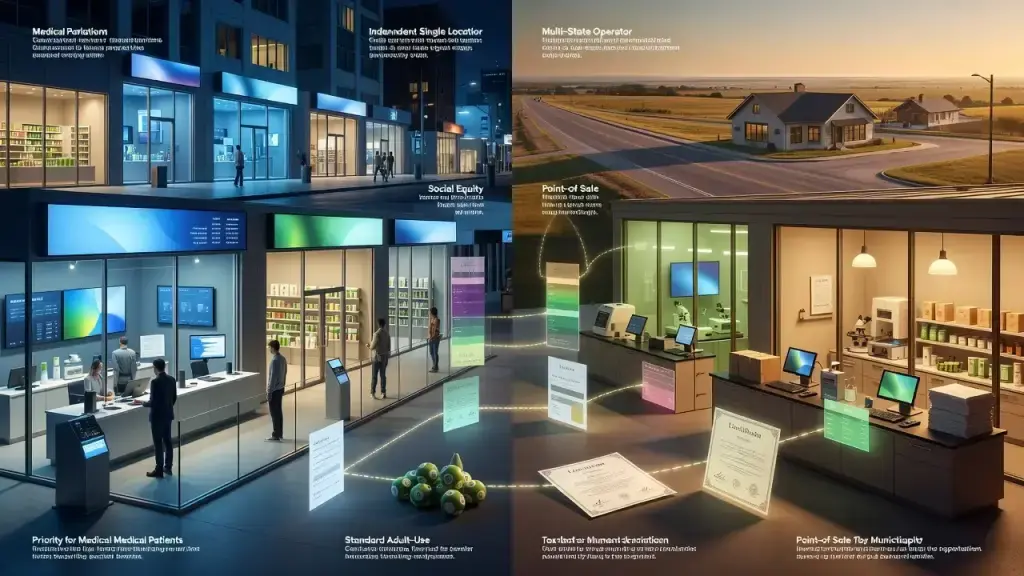
Illinois built social equity provisions into its licensing framework specifically to bring operators from communities disproportionately affected by prohibition into ownership roles. The rollout moved slower than many applicants expected, and that pace drew legitimate criticism. What it produced on the retail side, though, is a market with a wider range of store models than a simple chain-versus-independent split would suggest.
- Single-location independents tend to compete on curation and staff product knowledge rather than volume.
- Multi-state and multi-location operators compete on selection breadth, consistent hours, and supply reliability.
- Tax totals vary by municipality, so out-the-door pricing - not shelf price - is the only honest basis for comparison between stores.
None of this is arbitrary. It's a regulatory structure that starts with a licensing lottery and ends at the point-of-sale terminal, and every link in that chain - testing, tracking, tax, and ownership rules - shows up somewhere on the customer's receipt.