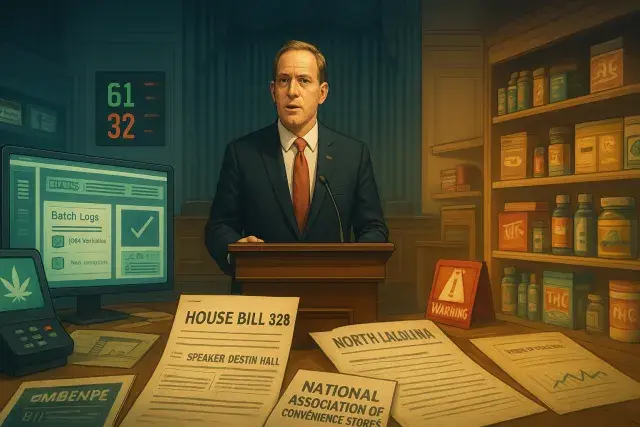
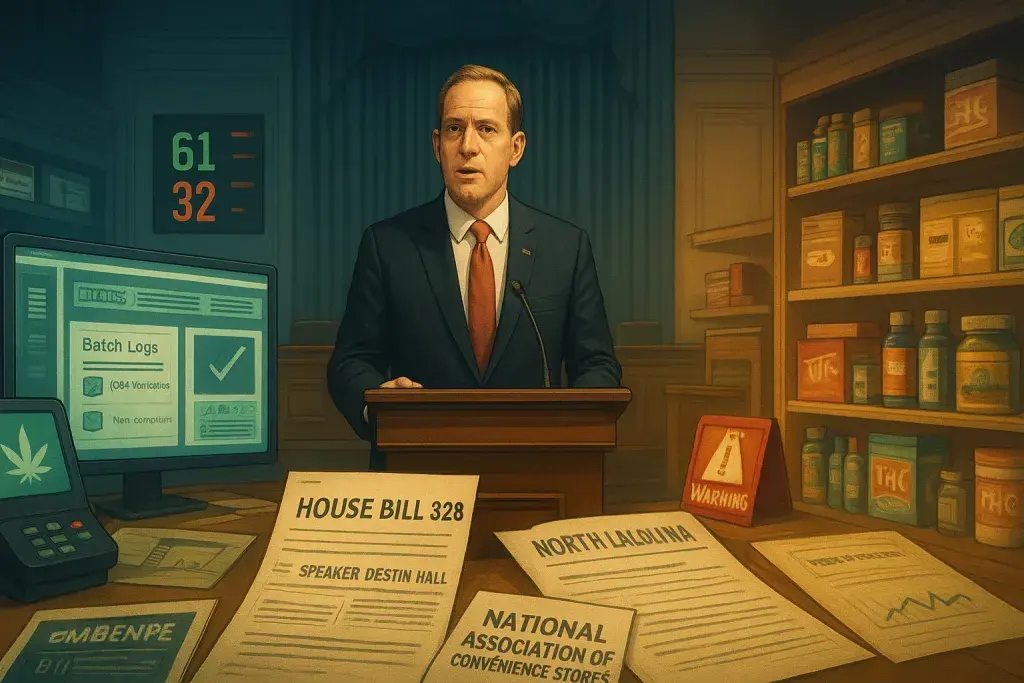
The Senate voted 61-32 on Aug. 8 to table an amendment from Sen. Ted Budd, R-N.C., that would have stripped a 30-day delay of federal hemp restrictions from the chamber's continuing resolution, keeping the new rules on track for a Dec. 11 effective date instead of Nov. 12. The outcome matters well beyond North Carolina: it determines how much runway operators nationwide get before a federal THC threshold reshapes what can legally sit on convenience store shelves and dispensary menus alike.
For licensed cannabis retailers operating under state seed-to-sale systems, the federal hemp fight is a reminder that compliance infrastructure has to stretch across two very different regulatory tracks - the state-licensed adult-use and medical markets tracked through Metrc, and the far looser hemp-derived market that has operated largely outside that framework. Operators in states with mature Metrc integration already know the drill: batch tracking, COA verification, and point-of-sale systems that flag non-compliant SKUs before they reach the register. In Utah, for instance, dispensaries running Metrc-compliant POS for Utah have built exactly that kind of reconciliation into daily operations, precisely because state auditors expect inventory logs to match tracked plant and product data down to the gram. The looser hemp retail channel - gas stations, grocery stores, vape shops - has no equivalent backbone, which is a big part of why Congress is fighting over how fast to close the gap. Metrc-compliant POS for Utah
What the Federal Threshold Actually Changes
The underlying law, passed in November 2025, redefines hemp based on total THC rather than delta-9 THC alone and caps finished hemp-derived products at 0.4 milligrams of combined THC and similar cannabinoids per container. That is a dramatically lower bar than what many intoxicating hemp brands - THC seltzers, gummies, vapes, delta-8 products, THCA flower - currently contain. Once enforced, the rule effectively removes most of that inventory from legal retail distribution, regardless of state law, unless products are reformulated below threshold. For wholesalers and brand owners, that means SKU-level reformulation decisions, relabeling, and in some cases discontinuing product lines entirely - not a small lift for companies that built wholesale menus around higher-potency formats.
A Fight Over Timing, Not Just Substance
Budd framed the dispute as child safety, citing packaging that mimics candy and snack brands and pointing to a steep rise in cannabis-related emergency visits among North Carolina minors. Opponents of his amendment - including 105 organizations ranging from the US Hemp Roundtable to the National Association of Convenience Stores - didn't dispute that the market needs tighter rules. Their argument was narrower: give Congress 30 more days to legislate age limits, good manufacturing practices, and import restrictions on synthetic cannabinoids, rather than let a blunt THC cap take effect without any accompanying regulatory framework. That's a real distinction for compliance teams. A hard cutoff with no transition period tends to produce chaotic inventory shrinkage and abrupt manifest changes; a phased regulatory buildout, in theory, gives distributors time to adjust wholesale pricing and packaging before enforcement begins.
North Carolina's Parallel, Unresolved Fight
The federal delay lands alongside a stalled state effort. House Bill 328 would write the same 0.4-milligram threshold directly into North Carolina law, along with a 21-and-older sales restriction, meaning the state ban could survive even if Congress ultimately softens the federal rule. The Senate approved the conference report 37-6 in July, but the House has repeatedly declined to vote on it, leaving the bill parked in the Rules Committee. Speaker Destin Hall says lawmakers agree the current unregulated market can't continue but haven't settled on how to fix it - which leaves North Carolina retailers, distributors, and compliance officers planning for a market that could look completely different depending on which chamber, and which government, moves first.