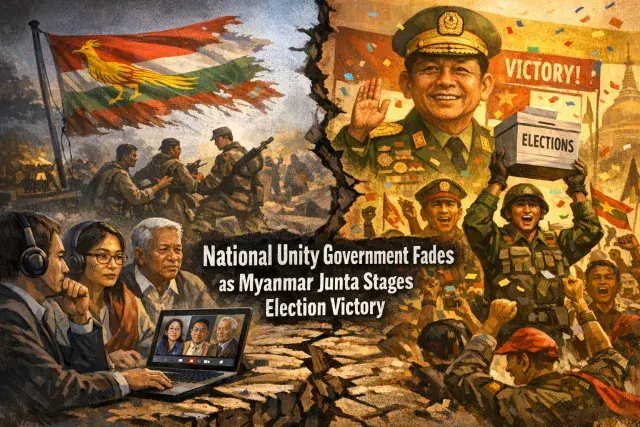
The National Unity Government, formed by pro-democracy leaders after Myanmar's military coup five years ago, struggles for relevance amid the junta's recent sham election. This shadow administration, once envisioned as the nation's sole legitimate voice abroad, controls no territory and fails to unify rebel forces against the regime. As the military cements power through a proxy vote, the group's exile-based operations expose deep fractures in the resistance.
Ambitions Unfulfilled in Exile
Politicians and civic leaders launched the National Unity Government in 2021, shortly after the military seized power on February 1, deposing the elected government. They established offices in Washington and London, plus restive areas inside Myanmar, and raised millions to arm ethnic rebels and form ministries. Leaders like acting president Duwa Lashi La and prime minister Mahnn Win Khaing Than aimed to reset the country by curbing Bamar ethnic dominance and fostering inclusivity.
Yet the group remains diffuse, with most members abroad. It holds Zoom meetings to address crises, such as the junta's election, but lacks command over battlefield allies. The military, entrenched since Myanmar's post-colonial era, holds urban centers and about half the territory, while the shadow government's illegal status limits its reach.
Sham Vote Exposes Resistance Weaknesses
The junta conducted elections in three phases last Sunday, confined to its controlled areas, with most opposition figures jailed, banned, or in hiding. Senior General Min Aung Hlaing's proxy party expects victory, despite a reported 54.1 percent turnout—the lowest in decades. The National Unity Government urged a boycott, estimating urban turnout near 20 percent in Yangon and Mandalay, reflecting exhaustion among civilians who voted to avoid harassment.
Independent analyst David Scott Mathieson argues the military shifted the political ground, capitalizing on apathy the shadow government failed to counter. "The N.U.G. literally couldn’t see that the ground was shifting beneath its feet," he said. This procedural facade allows the regime to dictate terms, sidelining the pro-democracy effort.
Critics Demand Accountability and Reform
Human rights lawyer U Kyee Myint, 80, once a supporter, now calls the group a civil society entity disconnected from popular needs. He cites financial opacity, including a November scandal involving the prime minister's office permanent secretary accused of nepotism and corruption, with no disclosed investigation results. Rebels in Mandalay report relying on local donations, with fighters down to 50-100 bullets.
Foreign minister Daw Zin Mar Aung defends the effort: "We started from zero," she said from hiding, urging constructive criticism. Spokesman Nay Phone Latt notes talks for a new alliance with ethnic groups and insists support continues, even if incomplete. Activist physician Tayzar San, despite dissatisfaction, warns against dissolution, as the group aids defense, education, and health in central regions like Sagaing, Mandalay, and Magway.
Recent cuts from 17 to 12 ministries signal internal response, but detractors like Tint Zaw Hein argue external leadership cannot sustain a prolonged civil war that has killed at least 7,700. With neighbors like China, India, and Thailand withholding recognition, the National Unity Government's path forward hinges on bridging exile and front-line realities to challenge Myanmar's entrenched dictatorship.