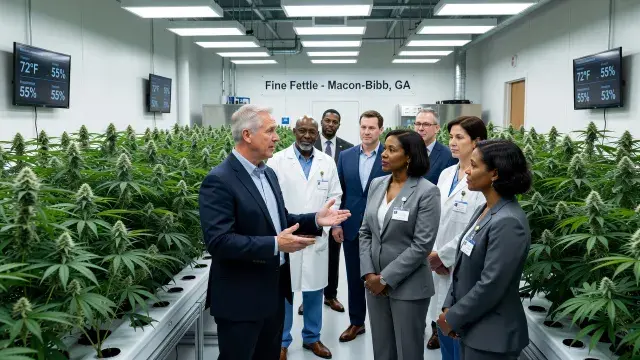
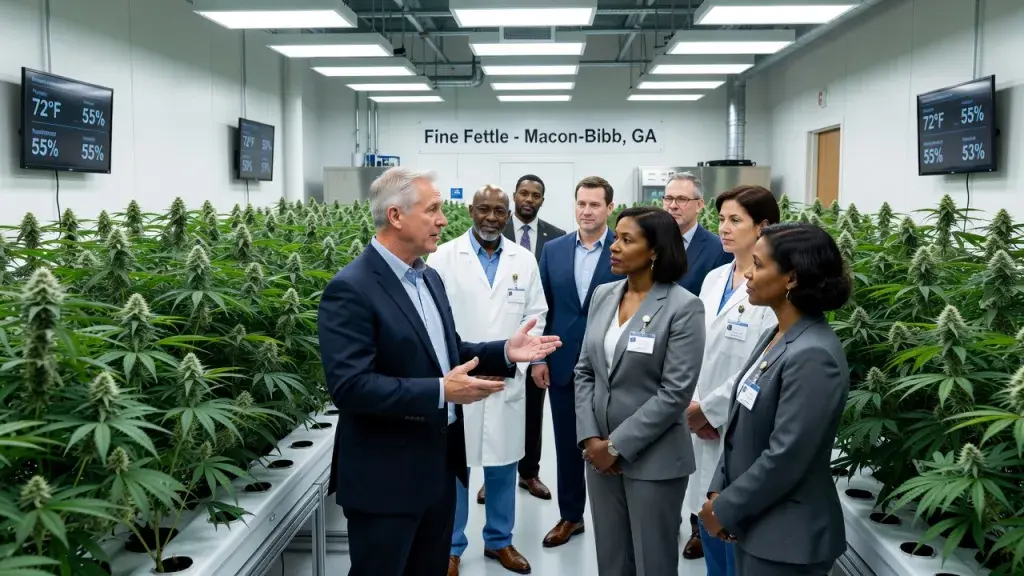
MACON-BIBB, Ga. - A decade after Georgia legalized medical cannabis, the program remains narrow, and lawmakers keep shelving the bills that would expand it. Fine Fettle, one of only three licensed producers in the state, decided to try a different approach this year: bring the legislature to the grow room instead of waiting for the legislature to come around on its own.
Judson Hill, market president of Georgia Fine Fettle, organized a facility tour in Macon that put state lawmakers, physicians, and patients in the same room as the plant itself - cultivation, manufacturing, and distribution, all under one roof. That kind of vertical integration is standard in limited-license medical markets, where a handful of operators are expected to handle everything from seed to shelf under close regulatory watch. Compare that to a state like Rhode Island, where operational maturity has advanced far enough that dispensaries now lean on tools like cannabis delivery software rhode island to manage last-mile logistics and compliance documentation. Georgia's program, by contrast, is still working to convince skeptical legislators that regulated cannabis production looks nothing like what they might picture.
Why the Facility Tour Mattered
State Representative Anissa Jones, who took part in the tour, said seeing the operation firsthand changed her understanding of how tightly controlled the process actually is. That's not a small point. Public skepticism about medical cannabis programs often traces back to a basic misconception - that production is loosely supervised or inconsistent from batch to batch. In practice, though, licensed operators in medical-only states like Georgia work under strict compliance logs, testing protocols, and product tracking requirements that leave little room for improvisation. Jones put it plainly: the same product needs to come out the same way, every time, so patients can rely on it.
That consistency is the whole point of a regulated supply chain. Batch testing, chain-of-custody documentation, and standardized manufacturing processes exist precisely so a patient's product doesn't vary wildly from one purchase to the next. For an operator like Fine Fettle, opening the doors to lawmakers is also a compliance flex of sorts - a way of showing that the infrastructure already meets a higher bar than critics assume.
What's Actually Stalled in the Legislature
Senate Bill 220 and House Bill 227 both aimed to expand Georgia's medical cannabis program, making it easier for patients to obtain a medical card and updating the allowable product forms to include more effective delivery methods. Neither bill made it through its chamber. That's the pattern here - proposals get introduced, generate some momentum, and then stall before reaching a floor vote.
Dr. Elmore Alexander, who joined the tour, raised a concern that resonates across limited medical markets nationally: current product offerings may serve the majority of patients, but a meaningful minority - he estimated around 20% - need product forms or formulations that aren't yet approved for sale in Georgia. Expanding product form isn't just a patient-access issue; it's a manufacturing and SKU-management question for licensed producers, who can only formulate what state law and regulatory guidance actually permit.
The Business Stakes of Program Expansion
For operators, a stalled legislature means a frozen addressable market. License caps, restricted product forms, and card-access barriers all limit patient enrollment, which in turn limits wholesale volume and revenue for the state's few licensed producers. Expanding access isn't just a policy win for patients - it's the mechanism by which Georgia's small medical cannabis sector could actually grow into a sustainable business category rather than a narrowly tolerated exception.
- Only three licensed medical cannabis operators currently serve the entire state of Georgia.
- Recent bills targeted easier medical card access and expanded approved product forms.
- Both SB 220 and HB 227 stalled in their respective chambers this session.
- Physicians point to a subset of patients who need product options not yet authorized.
None of this changes overnight. But facility tours, doctor testimony, and patient stories are the slow, unglamorous groundwork that eventually moves regulatory language - and in a state where the same bill keeps dying in committee, unglamorous groundwork may be the only path left.