
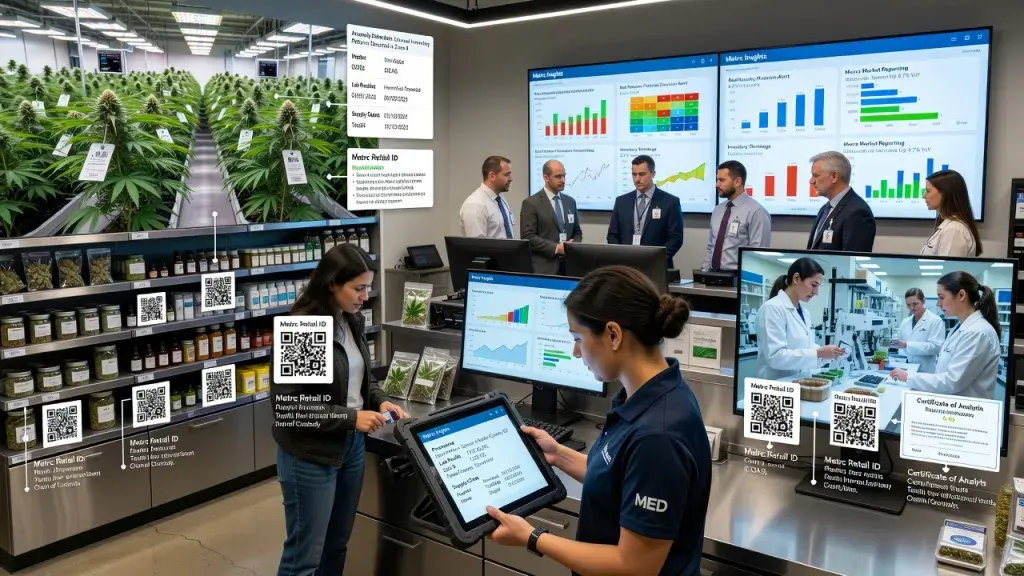
Colorado's Marijuana Enforcement Division has renewed its contract with Metrc to run the state's seed-to-sale tracking system, extending a vendor relationship that began in 2014. The deal matters beyond Colorado's borders: it reaffirms Metrc's position as the default infrastructure layer for cannabis compliance in one of the industry's oldest adult-use markets, and it adds two product features that could reshape how retailers handle labeling and how regulators hunt for diversion.
Why Switching Vendors Rarely Happens
Track-and-trace contracts don't get rebid the way a POS vendor might. Once a state builds its compliance logs, inventory tracking, and tax reporting around a single platform, and trains thousands of licensees on that platform's workflows, the cost of ripping it out is enormous. Dispensary staff, cultivators, and testing labs all learn the same tagging conventions, the same manifest procedures, the same reporting cadence. Replace the system and you're retraining an entire license base overnight, while regulators risk gaps in oversight during the transition. That's the structural reality behind Metrc's renewal, and it's why the company holds the largest share of state regulatory contracts by volume. Fair enough to call it a moat; it's one built on operational inertia as much as product quality.
Colorado's role as a first-mover state adds weight here. Its regulatory framework has served as a reference point for states that legalized later, so a renewed, upgraded contract signals continuity rather than disruption for an industry that still runs on a patchwork of fifty different rulebooks. There is no federal track-and-trace mandate - cannabis remains Schedule I - so each state sets its own data requirements, audit rules, and reporting timelines. That fragmentation is exactly what keeps incumbents entrenched.
What's New: Analytics and Retail ID
Two additions stand out. Metrc Insights gives MED staff a data layer for macro-level market reporting plus anomaly and risk-detection tools - in plain terms, a way to flag unusual inventory movement or reporting patterns before they become compliance violations or diversion cases. Metrc Retail ID moves in a different direction, placing item-level QR codes on products that encode provenance, lab-testing results, and supply chain data.
- For regulators, the analytics layer promises earlier detection of inventory shrinkage, mislabeling, or unusual wholesale pricing patterns.
- For retailers, item-level QR codes could simplify compliant packaging work, since product information no longer has to be printed and reprinted every time a label requirement shifts.
- For consumers, scannable codes offer a path to see lab results and batch data before purchase, which lines up with the kind of supply-chain transparency now standard in food and pharmaceutical regulation.
The Operational Stakes for Retailers
None of this is free of friction. New QR-code schemes mean updated packaging workflows, and any change to compliant packaging requirements tends to ripple through budroom inventory management and vendor relationships at the dispensary level. Operators should expect some adjustment period as the Retail ID system rolls out, particularly around how product batches get coded and how COAs get linked to individual units rather than just batch numbers.
The bigger-picture implication is about federal uncertainty, not state mechanics. If cannabis rescheduling or broader federal reform eventually requires a national reporting layer, a vendor already embedded in thirty state contracts and serving growers, testing facilities, dispensaries, regulators, and law enforcement alike would have a considerable head start. That outcome remains speculative, and nothing in this renewal commits Colorado or Metrc to any federal framework. But the structural point stands: in a state-by-state compliance system, scale and incumbency compound. Colorado just gave Metrc another decade-plus of runway to prove that out.