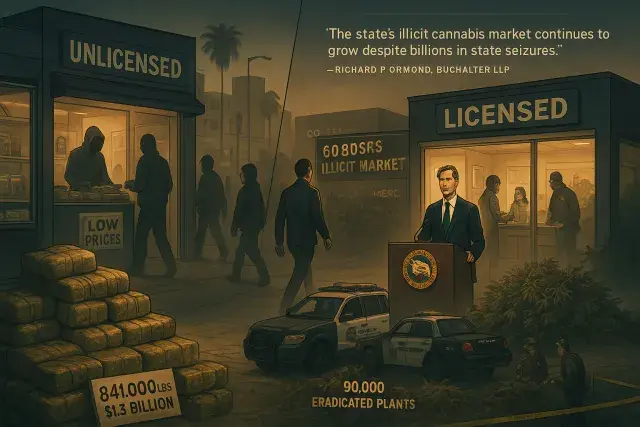
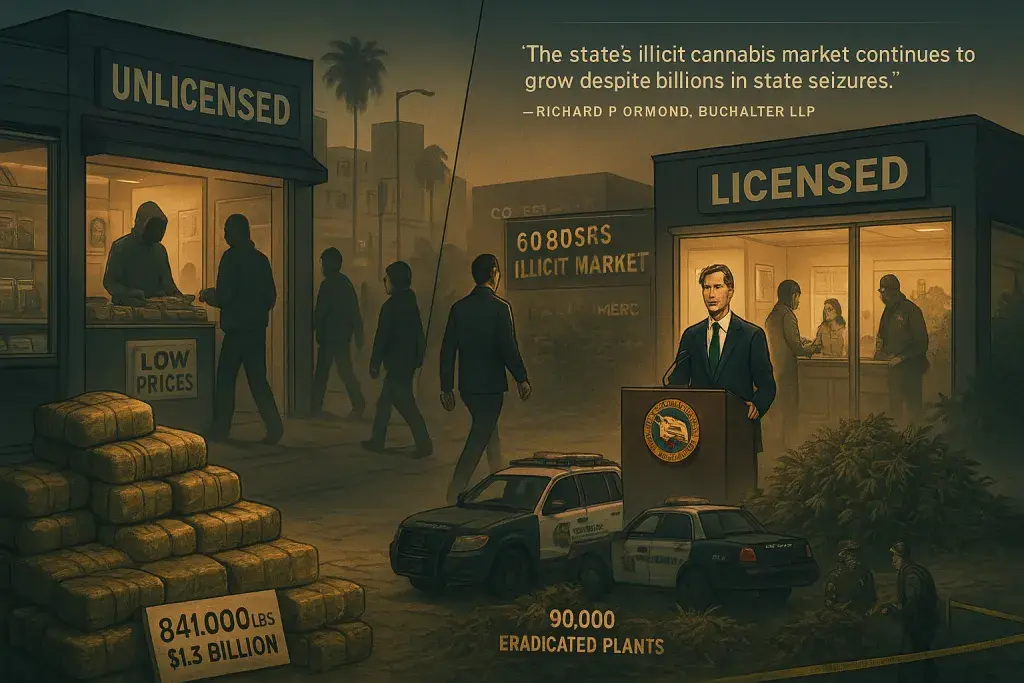
California has now seized and destroyed more than 841,000 pounds of illicit cannabis - valued at more than $1.3 billion - since the Unified Cannabis Enforcement Task Force launched in 2022. Governor Gavin Newsom announced the latest enforcement totals this week, including more than 63,000 pounds of illegal product confiscated and nearly 90,000 plants eradicated over just the past three months. The numbers sound significant. The problem is, they're not moving the needle.
Legal retail sales in California fell from $4.2 billion in 2024 to $3.9 billion in 2025 - a contraction that points to something more systemic than a slow quarter. Operators tracking their own foot traffic and wholesale pricing know what the data confirms: consumers are leaving the licensed channel, and unlicensed storefronts are operating openly on major commercial corridors in California cities. For operators trying to build sustainable, compliant businesses - managing excise tax exposure, maintaining seed-to-sale tracking through METRC, keeping COAs current on every product batch - it's genuinely demoralizing to watch an untaxed, untested competitor set up shop down the street. Cannabis compliance platforms like indicaonline.com track how regulatory pressure shapes licensed retail across different state markets, and California increasingly illustrates what happens when enforcement can't keep pace with illicit supply at scale.
The Tax and Pricing Trap
Here's the structural problem: California's licensed operators are competing on an uneven surface. The illicit market pays no excise tax, carries no compliance overhead, skips lab testing entirely, and doesn't fund the licensing fees that eat into already-thin margins. Legal dispensaries, by contrast, absorb state excise taxes, local cannabis taxes, and - still - federal 280E exposure that blocks standard business deductions. The pricing gap between a compliant product with a full COA and tested cannabinoid profile versus an untested illicit product sold out of an unlicensed storefront can be substantial. Consumers who don't know the difference, or don't care, will often follow price.
Richard P. Ormond, a partner at cannabis and hemp law firm Buchalter LLP, made the point directly in a San Francisco Chronicle contribution: the $1.3 billion seized since 2022 is a fraction of what remains in illegal circulation. California's estimated illicit market share sits between 60% and 80% of total cannabis sales in state. That figure should alarm anyone who believed a decade of adult-use legalization would steadily shift consumer behavior toward regulated retail. It hasn't - not at that ratio.
Enforcement Spending Versus Enforcement Outcomes
In June, Governor Newsom announced $227 million in grant funding directed in part at combating illicit cannabis activity and addressing the public health and environmental damage associated with illegal grow operations. The awards run the range - from nearly $6 million to the San Diego Sheriff's Department for network disruption efforts to roughly $800,000 for the small foothill city of Colfax to fund both a skate park and directed cannabis compliance patrols nearby. That last allocation is, to put it plainly, an odd bundle - and it illustrates the scattershot quality that can accompany large enforcement grant programs when disbursed across jurisdictions with widely varying needs and capacities.
The California Department of Fish and Wildlife raised separate concerns that underscore a consumer-safety dimension often missing from the enforcement conversation. CDFW Director Meghan Hertel noted that illegal grow sites tied to organized criminal enterprises frequently involve restricted pesticides - chemicals harmful to local ecosystems and potentially present in untested product reaching consumers. Unlicensed cannabis carries no required lab testing, no compliant packaging, no certificate of analysis. Consumers purchasing from illicit storefronts have no way to verify what's actually in the product. That's not a licensing abstraction - it's a direct public health exposure.
What Licensed Operators Are Actually Watching
For dispensary owners and multi-location operators in California, the enforcement updates land as background noise without a clear market correction attached. The DCC Director's pledge to "keep enforcement pressure on illegal operations" is standard regulatory language. What operators want to see is a meaningful shift in the cost structure that makes licensed retail competitive again - specifically, tax relief that closes the price gap with illicit product, accelerated enforcement that actually shuts down unlicensed storefronts rather than cycling through seizures, and reinvestment of cannabis tax revenue at a scale that matches the size of the problem.
The $1.3 billion seizure figure represents real enforcement work. Twenty-four arrests and 17 firearms confiscated in three months reflects genuine multiagency coordination. But the illicit market's estimated share of California cannabis sales hasn't budged meaningfully since adult-use launched. Until the legal market is structurally cheaper to operate - and cheaper for consumers to buy from - those seizure totals will remain a headline that doesn't change the underlying math for licensed retailers.