Regulated cannabis retail is not a forgiving business. Operators face compounding pressure from compliance obligations, tight margins, and the constant demand to run a storefront that performs under scrutiny - all while the broader market continues to mature unevenly across state lines. For dispensary owners, the question isn't whether conditions will get harder. It's whether their internal systems are positioned to absorb the strain.
That operational readiness starts at the technology layer. Point-of-sale infrastructure, inventory management, and seed-to-sale tracking integrations are no longer back-office considerations - they're the connective tissue of a compliant retail operation. Operators in markets like Oregon, for instance, have long wrestled with the tension between regulatory reporting requirements and the practical demands of running a busy budroom. Reliable cannabis pos software oregon dispensaries use has to handle METRC synchronization, purchase limits, compliance logs, and SKU management without creating workflow friction at the counter. That's a taller order than it sounds - and when systems fail to deliver, the consequences land on the compliance side, not just the operational one.
The thing is, technology alone doesn't solve the underlying economics. Adult-use markets in particular face a persistent margin compression problem. Wholesale pricing has declined in many mature markets as licensed cultivation supply catches up with - and in some cases outpaces - retail demand. That shifts pricing power toward larger operators and multi-state operators with vertical integration, leaving independent dispensaries to manage tighter spreads on every unit sold. Add excise tax obligations and the continued inability to take standard federal business deductions under 280E, and the arithmetic gets uncomfortable fast.
Compliance Costs Don't Scale the Way Revenue Does
What's striking about the current moment in regulated cannabis retail is how compliance overhead tends to grow alongside a store's transaction volume - but rarely in proportion to the revenue gains. A dispensary processing more daily transactions still needs the same compliant packaging protocols, the same age-verification procedures at the point of sale, the same COA documentation for every product batch on the shelf. None of that gets cheaper at scale unless the operator has invested deliberately in systems that automate the repetitive compliance work.
For store managers, this shows up as labor cost that's hard to justify on a P&L but impossible to cut. Budtenders aren't just sales staff - they're the last human checkpoint in a compliance chain that runs from licensed cultivator through the supply chain to the consumer. Retail staff training on product safety, purchase limits, and responsible retailing protocols isn't optional; in most state frameworks, it's an auditable requirement. Operators who treat compliance as a checkbox exercise rather than an operational discipline tend to find out the hard way that regulators see the same distinction.
Payments Remain an Unresolved Pressure Point
Cashless payment options at cannabis dispensaries have expanded in recent years - but the infrastructure underneath remains fragile and, in some configurations, legally ambiguous. Many operators have adopted ATM-cashback models, PIN-debit workarounds, or third-party cashless payment platforms as substitutes for traditional card processing. These solutions reduce cash-handling risk and improve transaction convenience. They don't, however, resolve the fundamental banking access problem that licensed operators face under federal prohibition.
For multi-location operators especially, cash management at scale is an operational and security liability. Delivery manifests for cash-heavy operations require additional controls. Insurance costs reflect the risk. And the absence of conventional merchant processing means operators can't benefit from the same payment data analytics that conventional retailers use to understand purchasing behavior. Fair enough - some workarounds do the job. But "workable" and "sustainable" aren't the same thing, and the payment gap remains one of the more concrete structural disadvantages licensed cannabis retail carries relative to other regulated consumer businesses.
What Operational Discipline Actually Looks Like
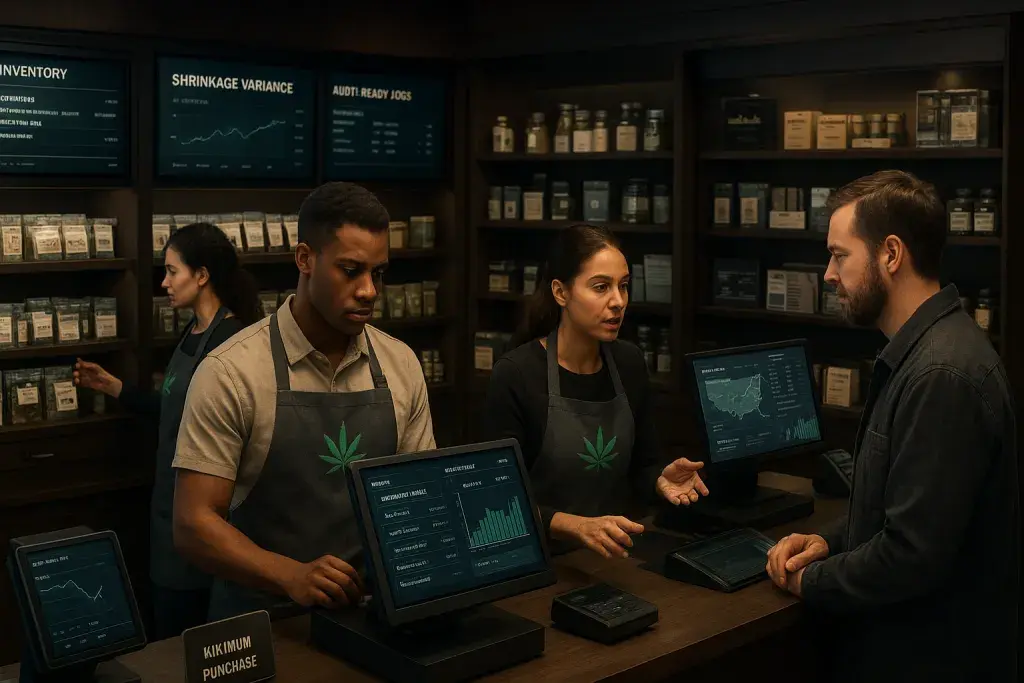
The dispensaries that weather market volatility tend to share a few traits - none of them particularly glamorous. They maintain clean inventory records with minimal shrinkage variance. Their POS terminals are integrated with state reporting systems in real time, not reconciled manually at the end of a shift. Their wholesale menus are negotiated with supply chain visibility, not just price. And their compliance logs are audit-ready on any given day, not reconstructed before a scheduled inspection.
That operational baseline isn't difficult to describe. It is, in practice, difficult to maintain - especially for independent operators running lean teams without dedicated compliance staff. The licensed cannabis business rewards consistency more than cleverness. Operators who build durable internal systems before they're forced to by a compliance event tend to be the ones still standing when the market consolidates further. That's the real business implication here - not any single market shift, but the compounding advantage of getting the fundamentals right early.