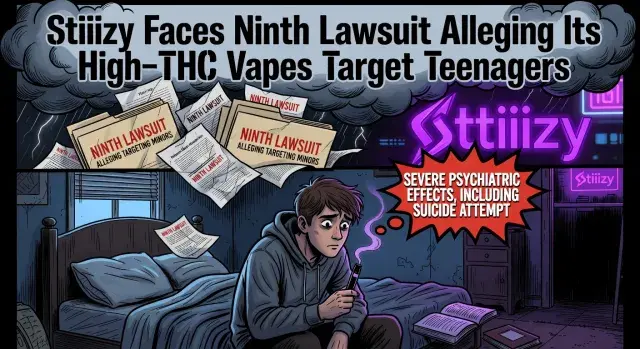
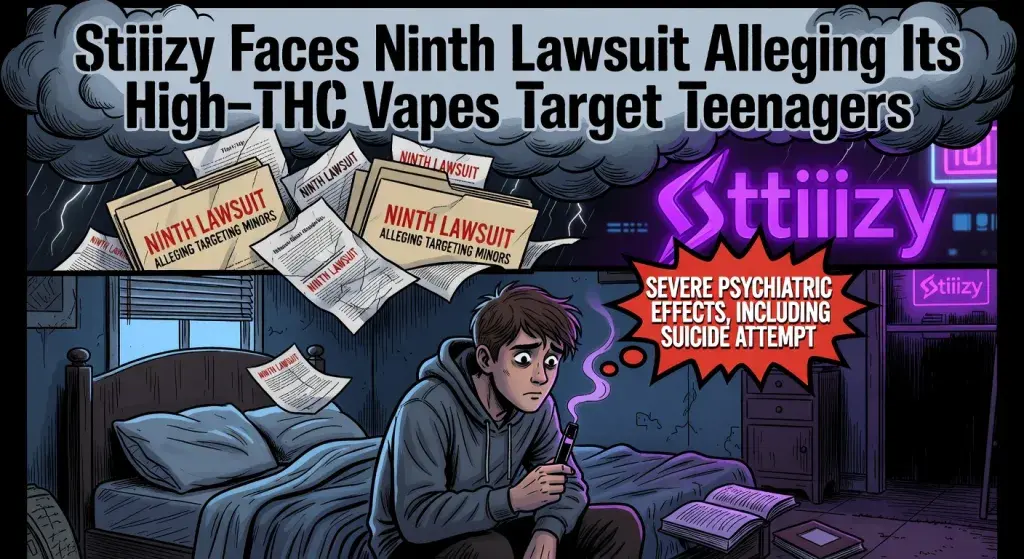
A California cannabis vape company is accumulating legal trouble at a notable clip. Stiiizy Inc., one of the most recognizable brands in the state's legal cannabis market, has been hit with yet another lawsuit - the ninth filed by the same group of attorneys - claiming the company deliberately markets high-potency THC vape products to minors. The latest plaintiff, a young man identified only as John Doe RC, says he began using Stiiizy products as a 17-year-old high school senior in 2024 and subsequently experienced severe psychiatric effects, including a suicide attempt.
The Allegations: Bright Colors, Weak Guardrails, and 92% THC
The complaint, filed in California state court and reported by Law360, paints a picture of a company whose branding strategy - intentionally or not - reads like a playbook for reaching adolescents. Flavor names like "Purple Punch," "Dreamsicle," and "Gelato." Vivid packaging. Advertising featuring young, attractive women. If you've watched Big Tobacco litigation unfold over the past three decades, the rhetorical framing will feel familiar.
Then there's the potency question. The lawsuit alleges Stiiizy vape pods contain THC concentrations as high as 92%. That number deserves a moment of context. Traditional cannabis flower - the kind that dominated the market for generations - typically contains THC levels somewhere in the range of 15% to 25%. Concentrated vape products can push well beyond that, and 92% sits at the extreme end. The complaint argues that this kind of potency carries a meaningfully higher risk of cannabis-induced psychosis, or CIP, particularly in adolescents whose brains are still developing.
The plaintiff also takes aim at Stiiizy's age-verification system online. According to the complaint, the company's website requires nothing more than a single click confirming the visitor is over 21. No ID upload, no date-of-birth entry, no third-party verification. Just a "Yes." That's less a gate than a suggestion.
Cannabis-Induced Psychosis: A Real Clinical Concern
CIP is not a novel invention of plaintiff's counsel. It is a recognized clinical phenomenon - a psychotic episode triggered or exacerbated by cannabis use, characterized by hallucinations, paranoia, disorganized thinking, and in some cases severe mood disturbance. The complaint cites figures showing CIP-related emergency room visits rose from 682 in 2016 to 1,053 in 2019. The broader medical literature has tracked growing concern about a dose-response relationship between THC potency and psychosis risk, with younger users considered especially vulnerable given the ongoing myelination and synaptic pruning occurring in the adolescent brain through the mid-twenties.
Here's the catch: the legal cannabis industry has moved relentlessly toward higher potency, driven by consumer demand and competitive pressure. Concentrates now represent a substantial share of dispensary revenue in states like California and Colorado. Regulatory frameworks vary widely - some states have considered or enacted potency caps, while others have no limits at all. The question of whether manufacturers bear a duty to warn about psychosis risk, or whether high-potency products are inherently defective, remains largely untested in court.
A Pattern of Litigation - and What It Signals
Nine lawsuits from the same legal team is not happenstance. It's a strategy. The claims span negligence, failure to warn, defective design, negligent misrepresentation, fraudulent concealment, and outright fraud. Eight have been filed in Los Angeles County; one in Marin County. Each seeks damages for past and future economic and noneconomic losses. The legal architecture here resembles early-stage mass tort campaigns - file repeatedly, build a factual record, test theories, and see which ones gain traction with judges and juries.
Whether these cases ultimately succeed is an open question. Cannabis companies operating in the legal market are selling a product that state regulators have licensed and, in some cases, tested. Defendants in these actions will likely argue that their products comply with California's regulatory framework, that age-gate systems meet industry norms, and that consumers - or their parents - bear some responsibility. But compliance with state regulation has never been an absolute shield against tort liability. Cigarette manufacturers operated within legal frameworks too.
What's striking here is the speed at which cannabis litigation is recapitulating tobacco's arc. The youth-marketing allegations, the potency-as-defect theory, the psychiatric injury claims - these are the building blocks of a broader legal confrontation between a rapidly maturing industry and the downstream health consequences it may be generating. Stiiizy may be the named defendant, but the entire high-potency cannabis sector is watching.