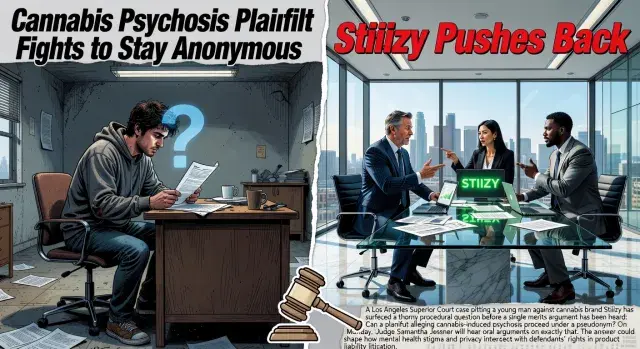
A Los Angeles Superior Court case pitting a young man against cannabis brand Stiiizy has surfaced a thorny procedural question before a single merits argument has been heard: Can a plaintiff alleging cannabis-induced psychosis proceed under a pseudonym? On Monday, Judge Samantha Jessner will hear oral arguments on exactly that. The answer could shape how mental health stigma and privacy intersect with defendants' rights in product liability litigation.
What the Plaintiff Alleges - and Why He Wants His Name Hidden
The plaintiff, identified only as John Doe in court filings, claims that his use of Stiiizy vape products as a minor triggered a cascade of psychiatric harm - psychosis, cognitive impairment, hospitalizations, and ongoing reliance on psychiatric medication. The complaint, filed in December 2024, includes causes of action for fraud, strict products liability, negligence, and breach of implied warranty.
The factual allegations are vivid and disturbing. In March 2022, Doe was reportedly found shirtless and soaking wet after jumping into a pool in the middle of the night; he later told a police officer that a classmate involved in witchcraft had cursed him. Ten months after that, standing beside his parents' car, he gestured to empty air and asked if he could bring a girl home - introducing his parents to no one. The following day, he locked his mother in her bedroom and declared that he "controlled" her.
In a sworn declaration, Doe argues that public disclosure of his identity would expose deeply private medical information - psychiatric diagnoses, substance abuse history, multiple hospitalizations - and jeopardize his future in education and employment. He also raises a cultural dimension: as an Asian-American, he says, the stigma attached to mental illness and drug use within his community compounds the risk of harm. And he voices fear that disclosure could invite harassment or even physical threats from what he describes as "potentially nefarious members and proponents of the marijuana industry."
Stiiizy's Response: No Special Treatment
Defense counsel is not having it. In their opposition papers, Stiiizy's attorneys argue that Doe has presented no concrete evidence of a reasonable fear of severe harm - the standard California courts typically require before granting pseudonymity. The only threats cited, they note, are online comments directed at plaintiff's counsel on public-facing advertising websites seeking potential claimants. That's a thin reed.
There's a practical objection too, and it's not trivial. Stiiizy's lawyers point out that granting anonymity in what they describe as a "coordinated, complex action" would impose real administrative burdens. Every brief, every declaration, every exhibit and hearing transcript would need to be scrubbed for accidental disclosure of Doe's actual name. In a case likely to generate voluminous discovery, that's not a small ask - for either the defense or the court.
The tension here is genuine. Courts have long recognized that pseudonymous litigation is the exception, not the rule. Open proceedings serve the public interest; they allow scrutiny of both parties. But exceptions exist - typically for minors, sexual assault survivors, and plaintiffs facing credible threats of retaliation. Doe's case sits in murkier territory. He's no longer a minor, and mental health stigma, while real, hasn't been uniformly accepted by California courts as grounds for anonymity.
The Broader Context: Cannabis, Youth Marketing, and Liability
Doe's underlying complaint paints a picture of aggressive brand-building aimed squarely at young consumers. According to the suit, Stiiizy's Pomona dispensary opening in June 2021 featured appearances by rappers Xzibit and Too Short. The brand reportedly partnered with Rolling Loud California - a four-day music festival - in what the complaint describes as an effort to "blend the electrifying world of Hip Hop with Stiiizy's pioneering cannabis culture." Doe alleges he chose Stiiizy vapes because they were "sleek," "cool and sophisticated," easy to use discreetly, and popular among his teenage peers.
Here's the catch: cannabis-induced psychosis is a clinically recognized condition, not a fringe theory. Psychiatric literature has documented associations between heavy cannabis use - particularly high-THC concentrates common in vape products - and the onset of psychotic symptoms, especially in adolescents and young adults with genetic predispositions. The condition doesn't affect every user, but its existence is well established enough that it appears in diagnostic manuals. Whether Stiiizy products specifically caused Doe's symptoms is, of course, a question of fact that the litigation itself will have to resolve.
What makes this case worth watching isn't just the anonymity dispute. It's the convergence of several forces: a rapidly commercializing cannabis industry, marketing tactics that critics say target young demographics, and a growing body of clinical concern about high-potency products. If Doe's case proceeds to discovery - anonymous or not - the internal documents and marketing strategies that emerge could prove far more consequential than the name on the complaint.
What Monday's Hearing Signals
Judge Jessner's ruling won't resolve the merits. But it will signal how California courts weigh mental health privacy against the presumption of open proceedings in an era when cannabis litigation is still finding its footing. A grant of pseudonymity could encourage other plaintiffs with similar claims to come forward. A denial might chill them - or, as Stiiizy's attorneys would likely argue, simply enforce the same rules everyone else plays by.
Either way, the substance of Doe's allegations isn't going anywhere. The question is whether the public will know who's making them.