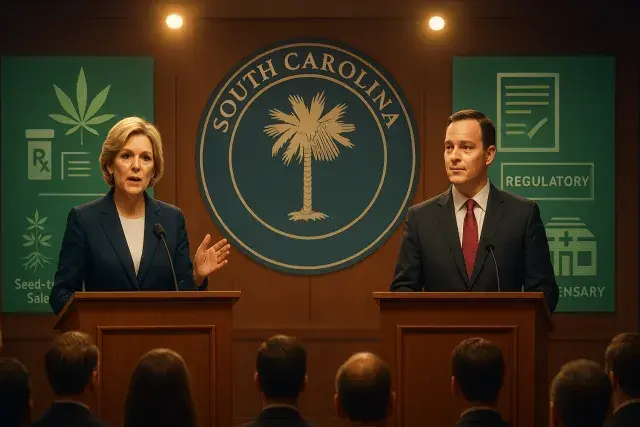
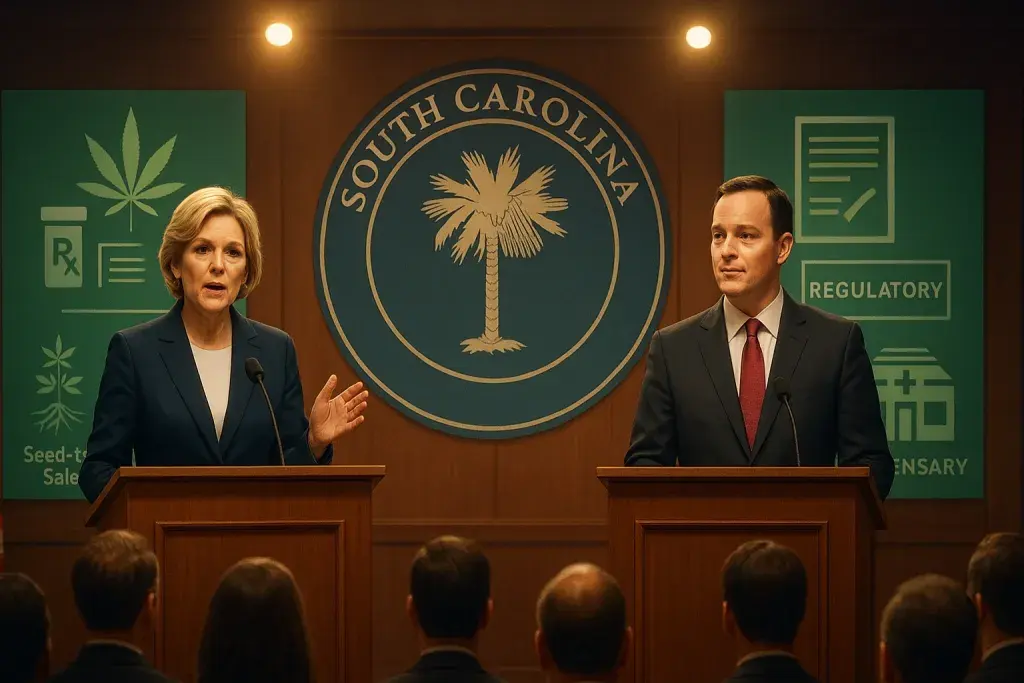
Both Republican candidates vying for the South Carolina governorship said during a debate this week that they would sign medical cannabis legislation under the right conditions - a notable shift in posture for a state that has never moved comprehensive medical marijuana law to a sitting governor's desk. The statements came from Lieutenant Governor Pamela Evette and Attorney General Alan Wilson ahead of their primary runoff election on Tuesday, and they carry real implications for an industry watching closely to see whether the Southeast's regulatory holdouts are finally beginning to move.
South Carolina remains one of a shrinking number of states without a functioning medical cannabis program. That puts it in increasingly rare company - even by the standards of conservative Southern states. Operators and investors tracking southeastern market expansion have learned to watch the political groundwork carefully; licensing frameworks, seed-to-sale tracking requirements, and dispensary regulations don't materialize overnight. States that eventually launch medical programs typically spend years in legislative debate before the first license is issued or a cannabis pos maine-style retail infrastructure is even a consideration for incoming operators. The policy signals from candidates matter early, because the distance between a gubernatorial endorsement and a functional regulated market is measured in legislative sessions, not months.
Evette framed her position in personal terms - her father's death from lung cancer - while drawing a clear regulatory line: any bill that reached her desk would need to be tightly drafted to prevent what she called "an open door to recreational use." She said she would consult medical and law enforcement experts before signing anything, and she acknowledged that no such legislation has cleared the General Assembly to date. That last point is worth sitting with. The governor's stated willingness is only one variable. South Carolina's legislature has seen medical cannabis bills introduced and stall repeatedly, which means the political calculus inside the statehouse remains the more immediate obstacle.
The Federal Rescheduling Argument Is Now Mainstream Republican Cover
Wilson's reasoning was telling. He tied his support for medical cannabis directly to the Trump administration's position on rescheduling marijuana from Schedule I to Schedule III under the Controlled Substances Act - framing it not as a departure from conservative orthodoxy but as alignment with federal direction. That's a meaningful rhetorical move. For years, state-level Republican resistance to medical cannabis relied partly on federal illegality as a principled justification. Rescheduling, if finalized, changes that argument structurally. It doesn't legalize cannabis at the federal level, but it does open the door to formal medical research and removes some of the legal awkwardness that has complicated pharmacy-adjacent dispensary models, banking access, and tax treatment under Section 280E.
Wilson also cited veterans dealing with PTSD and patients with seizure disorders and terminal illness - constituencies that tend to generate bipartisan sympathy in legislative chambers. These are the same patient populations that helped crack open medical programs in other red states. For B2B operators watching South Carolina, the framing matters: a medical program built around narrow qualifying conditions and tight regulatory controls is a different market than a broad adult-use framework, and it shapes everything from license cap structures to product category limits to the wholesale supply chain that would eventually service dispensaries.
What the Democratic Position Adds to the Picture
Democratic nominee Jermaine Johnson is running on a broader platform - medical access, a statewide cannabis excise tax structured around budget relief, sentence commutation for nonviolent marijuana offenses, and a public referendum on adult-use legalization. Whether or not Johnson wins, his platform sets the outer boundary of the policy conversation and gives the Republican candidates something to differentiate against. That dynamic - a Democrat pushing full adult-use while Republicans position themselves as the responsible medical-only alternative - has played out in other state cycles and sometimes produces workable medical frameworks faster than pure opposition does.
For dispensary operators, multistate operators, and cannabis technology vendors evaluating potential entry into South Carolina, none of this is a green light. A governor willing to sign medical legislation is not the same as a legislature willing to pass it, a regulatory agency ready to build a licensing program, or a compliance framework that would tell operators what tracking systems, packaging standards, lab testing protocols, or point-of-sale requirements they'd actually be working under. Those details take years to develop. What this week's debate does signal is that the gubernatorial veto - historically a reliable ceiling on progress in the state - may be less of an obstacle in the next administration than it has been in the current one.
The Operational Clock Doesn't Start at the Debate Podium
Here's the practical read for the industry: South Carolina is worth watching, not acting on. The gap between political openness and a functioning regulated market involves drafting enabling legislation, standing up a licensing authority, writing administrative rules, fielding license applications, and building the compliance infrastructure that makes seed-to-sale accountability possible. In states that have gone through that process, the timeline from first legislative passage to first legal sale has routinely stretched across multiple years.
Operators who moved aggressively into early-stage markets without that groundwork have paid for it - in stranded capital, in regulatory delays, in compliance retrofits when rules were finalized differently than expected. South Carolina's signals are meaningful for long-range planning. They are not a cue to break ground.