Federal rescheduling of cannabis has carried enormous symbolic weight for the industry, but the financial relief many operators expect it to deliver is far more limited than the prevailing narrative suggests. Moving cannabis to Schedule III would not make the plant federally legal. That single fact - consistently underweighted in optimistic projections - is where most of the industry's banking and payments assumptions break down.
The compliance infrastructure banks already maintain to serve cannabis businesses wouldn't simply dissolve under a new schedule designation. Operators running dispensaries in state-licensed markets - from multi-location adult-use retailers to single-site medical programs - deal daily with the downstream effects of that infrastructure gap: cash dependency, limited POS optionality, restricted merchant accounts, and expensive workarounds. For those tracking how technology vendors are adapting, resources like cannabis pos systems maryland offer a window into how operators in regulated markets are already building around structural financial constraints rather than waiting on federal action. That pragmatism is instructive. The operators who have stopped treating rescheduling as a solution are often the ones running tighter operations right now.
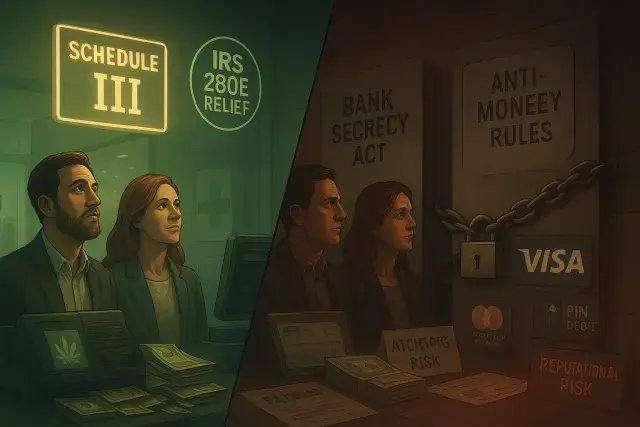
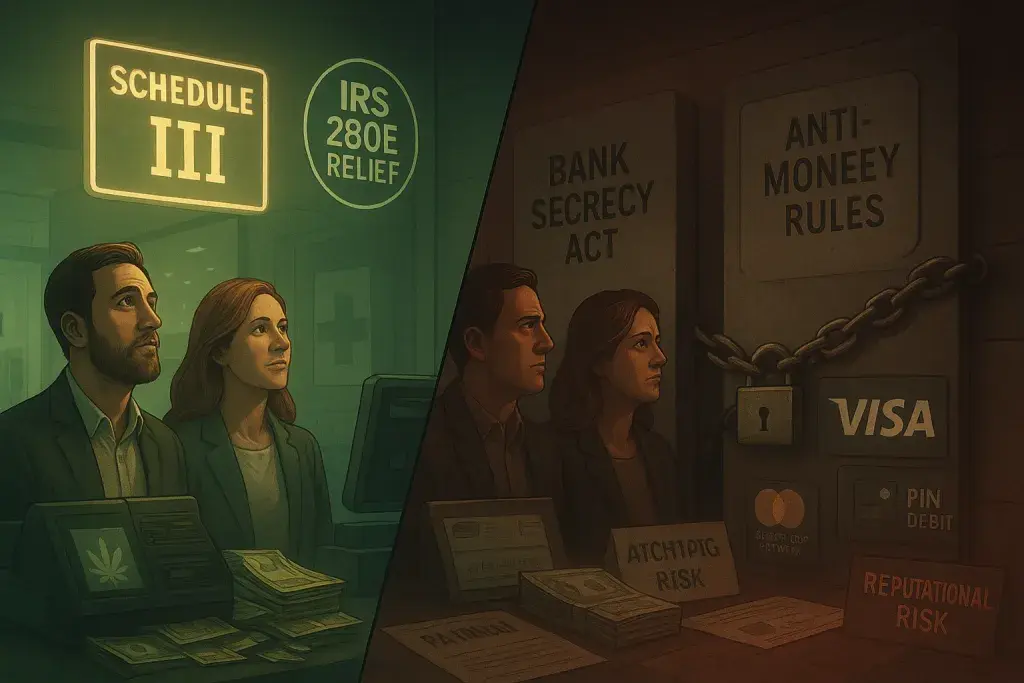
Here's the catch: the Bank Secrecy Act and anti-money laundering obligations that govern financial institutions serving cannabis businesses don't get lighter under Schedule III. They may actually get heavier. New federal frameworks tied to pharmaceutical oversight, interstate commerce considerations, and DEA registration requirements could introduce compliance layers that cost banks more to manage than the current patchwork does. The economics were already thin. Smaller community banks and credit unions entered cannabis precisely because they could build niche compliance programs at a scale that made sense for their balance sheets. Major national institutions looked at the same math and walked.
Why Visa and Mastercard Won't Be Moving Quickly
The assumption that Schedule III would unlock mainstream card processing is one of the industry's most persistent misconceptions. Visa and Mastercard operate across dozens of international markets, many of which maintain strict prohibitions on cannabis-related financial activity. Even if U.S. federal posture softens incrementally, the global exposure calculus for major payment networks doesn't change overnight. Drug trafficking liability concerns, reputational risk, and the absence of clear federal legalization all remain live issues for organizations operating at that scale.
It's also worth being specific about what the current workaround ecosystem actually looks like. Much of the cashless payment volume moving through cannabis retail today relies on systems that were built outside traditional card rails - ACH-based transfers, PIN debit structures, and closed-loop solutions developed specifically because Visa and Mastercard weren't at the table. Those systems aren't perfect. Some have faced regulatory scrutiny. But they exist because the market demanded them, and they've produced a parallel payments infrastructure that cannabis operators now depend on operationally. Rescheduling doesn't automatically replace that ecosystem; it may just add new compliance requirements on top of it.
280E Relief Is Real - But It Has Conditions
The clearest upside of Schedule III is relief from IRS Code 280E, the provision that prevents cannabis businesses from deducting ordinary operating expenses on federal taxes. For operators running on compressed margins - carrying payroll, inventory replenishment, retail buildout costs, and excise tax obligations simultaneously - that relief would be meaningful. Real, measurable, and overdue.
The tradeoff, though, is that medical operators under a Schedule III framework could face DEA licensing requirements, annual registration fees, and a new set of reporting obligations that haven't been fully defined yet. Operators running integrated programs - serving both medical patients and adult-use consumers under one license structure - may eventually face a decision about whether the medical side still pencils out if federal compliance costs rise sharply. Some could exit medical markets entirely and operate solely under adult-use frameworks, which would keep them at Schedule I exposure anyway. That's not a theoretical edge case; it's a real business calculation that finance-minded operators are already modeling.
SAFE Banking and the Limits of Legislative Optimism
SAFE Banking legislation has circulated in various forms for years, and the industry has treated its potential passage with the same finish-line energy as rescheduling. The sober read is that current SAFE Banking proposals primarily extend protections to financial institutions already serving cannabis businesses - a meaningful but narrow benefit. The legislation doesn't compel major banks to enter the space, doesn't eliminate compliance burdens, and doesn't require payment networks to open their rails to cannabis merchants.
What it would do is reduce the legal risk for community banks and credit unions that have already built programs. That's useful. It's not transformational. And it certainly doesn't mean a cannabis operator in a heavily regulated adult-use market would suddenly find themselves with the same financial tools as a conventional CPG brand. The structural reality is that cannabis banking challenges are rooted in federal illegality, not scheduling category - and Schedule III doesn't change that root.
Operators who have planned their financial infrastructure around rescheduling as a catalyst should recalibrate. The transition period, if and when it arrives, may prove more operationally complicated than the environment they're already managing. That's not pessimism - it's the kind of clear-eyed planning that keeps licensed businesses solvent through regulatory uncertainty.