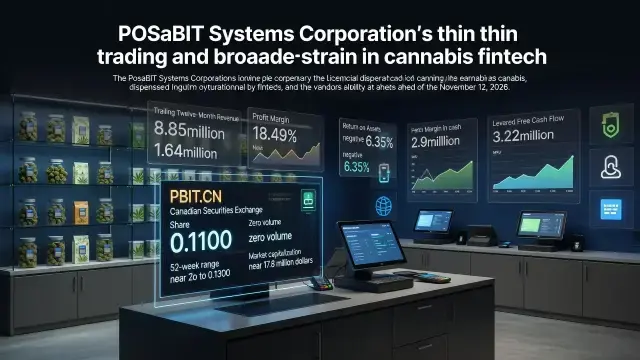
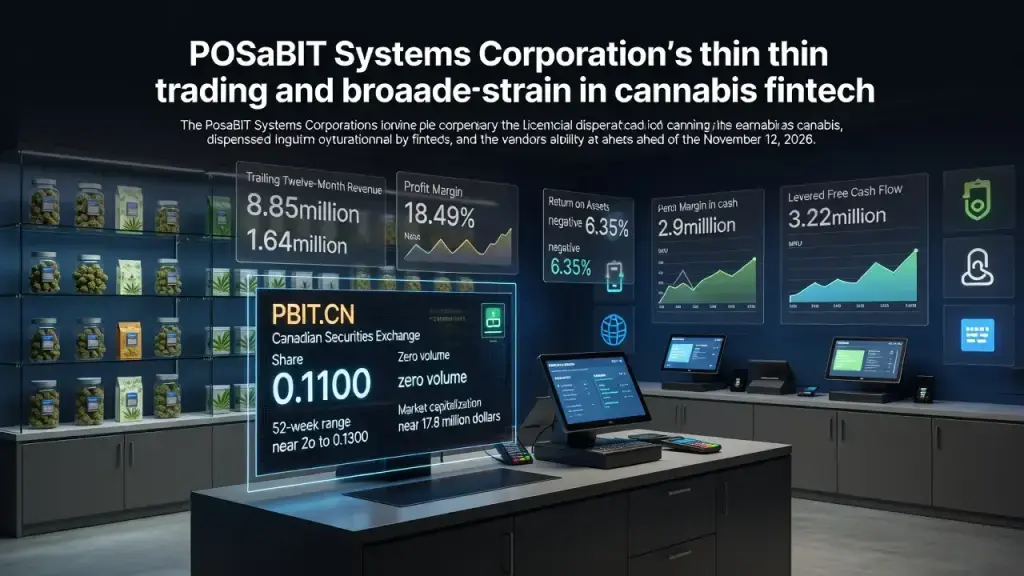
POSaBIT Systems Corporation, trading on the Canadian Securities Exchange under PBIT.CN, closed a recent session at 0.1100 with zero volume reported and a 52-week range stretching from effectively nothing up to 0.1300. A market capitalization near 17.8 million dollars, set against trailing revenue of 8.85 million and a net loss of 1.64 million, tells a familiar story for companies operating at the intersection of cannabis retail and payment technology: real revenue, persistent losses, and a stock price that barely moves because almost nobody is trading it.
What POSaBIT Actually Does
POSaBIT built its business around point-of-sale systems and cashless payment processing for licensed cannabis dispensaries, a niche that exists because federally regulated banks still largely refuse to touch plant-touching cannabis businesses. That reluance has forced the entire industry toward workarounds - cash-heavy operations, closed-loop payment apps, and compliant point-of-sale platforms that double as inventory and seed-to-sale tracking tools. For dispensary operators, a vendor like POSaBIT isn't just a checkout terminal. It's the system that reconciles daily sales against METRC reporting, manages SKU-level inventory across budroom shelves, and generates the compliance logs regulators expect during an audit.
Why the Numbers Look the Way They Do
A profit margin of negative 18.49 percent and return on assets of negative 6.35 percent aren't unusual for a small-cap cannabis technology vendor still scaling toward consistent profitability. What's more telling is the balance sheet: 2.9 million in total cash against levered free cash flow of 3.22 million suggests the company is generating cash from operations even while posting a net loss on paper - a pattern that can reflect timing differences in working capital, deferred revenue recognition, or one-time charges rather than a straightforward cash crisis. Still, thin trading volume and a market cap under 18 million dollars mean the stock carries real liquidity risk for any investor trying to enter or exit a position quickly.
What This Means for Dispensary Operators and the Payments Sector
For multi-state operators and independent dispensary owners evaluating point-of-sale vendors, a supplier's financial stability matters as much as its feature set. A payments or POS provider that's thinly capitalized introduces operational risk: software updates, compliance patches tied to state tracking systems, and customer support can all suffer if a vendor is stretched thin financially. That's a quieter risk than a failed bank account or a 280E tax surprise, but it's real - switching core retail infrastructure mid-year is disruptive and expensive.
The cannabis payments space remains fragmented precisely because federal law hasn't caught up with state-legal markets. Until that changes, dispensaries will keep relying on a patchwork of cashless ATM-style systems, state-chartered banking relationships, and specialized POS vendors - and the fortunes of those vendors, POSaBIT included, will stay tied to how quickly the broader cannabis retail sector matures toward normalized, bank-friendly commerce.
- Market capitalization: approximately 17.8 million dollars (intraday)
- Trailing twelve-month revenue: 8.85 million, with a net loss of 1.64 million
- Total cash on hand: 2.9 million, against levered free cash flow of 3.22 million
- Next scheduled earnings date: November 12, 2026
None of this amounts to an investment recommendation. For operators, the lesson is procurement due diligence: vet a point-of-sale or payments vendor's financial footing the same way you'd vet a wholesale supplier's delivery manifests or a landlord's lease terms. For investors, a low-volume micro-cap on a secondary exchange carries risks that go well beyond the headline price.