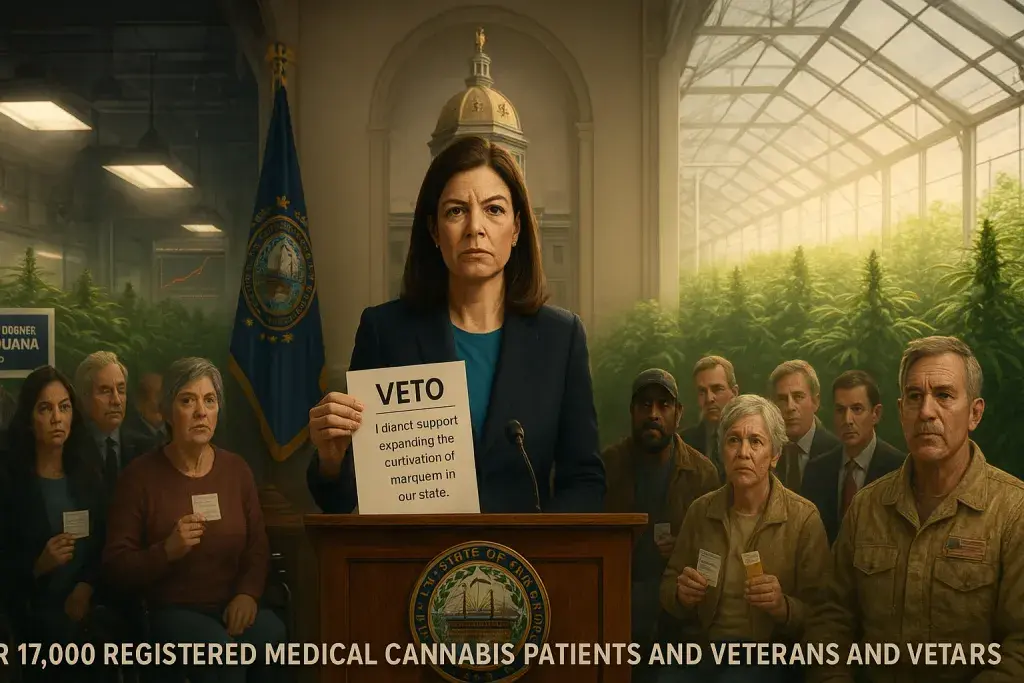
New Hampshire Gov. Kelly Ayotte (R) last month vetoed legislation that would have allowed the state's licensed alternative treatment centers to cultivate medical cannabis in greenhouses - a move supporters say will keep prices elevated for more than 17,000 registered patients and veterans who rely on the program. The bill, SB 468, passed both the Senate and House in voice votes this session, drawing rare bipartisan support. Now, a veto override effort is underway, and the governor's decision has become fodder in what is shaping up to be a competitive 2026 race for the Granite State's corner office.
The operational logic behind the greenhouse proposal is straightforward. Indoor cannabis cultivation - the kind conducted under high-intensity artificial lighting in sealed facilities - carries significantly higher energy costs than greenhouse growing, which uses natural sunlight as the primary light source. Those energy costs don't disappear; they move directly into wholesale pricing and, eventually, onto the shelf. For licensed operators in tightly regulated medical programs, where patient purchasing is tracked and supply is controlled by a limited number of state-registered dispensaries, there's no competitive pressure from adjacent markets to absorb those costs quietly. Patients pay them. The greenhouse model is widely used in mature cannabis markets - it's the same basic logic that underpins cost-efficiency discussions in states where operators use platforms like an Illinois dispensary POS platform to track cultivation-to-sale margins across vertically integrated operations. The bill's own language made the cost-reduction purpose explicit, stating that greenhouse authorization was intended "to reduce energy costs and provide lower prices for registered qualifying patients."
Ayotte's veto statement offered no policy detail. "I do not support expanding the cultivation of marijuana in our state," she said - full stop. That one-line explanation frustrated bipartisan supporters, including Sen. Howard Pearl (R), the bill's lead sponsor, who called it "a practical way to lower costs for patients with serious medical conditions." Sen. Tara Reardon (D) was more pointed, saying the veto denies "cost-saving measures for more than 17,000 veterans and patients." The only formal opposition during testimony came from a former state lawmaker now chairing the prohibitionist group Smart Approaches to Marijuana NH. That's a thin opposition coalition for a veto that affects a working medical program.
The Politics Running Parallel to the Policy
Cinde Warmington, currently the sole Democratic candidate seeking to challenge Ayotte in November, moved quickly to frame the veto as a health care affordability issue rather than a cannabis issue. "Shouldn't we be trying to make health care more affordable for Granite Staters, not less?" she said in a social media video posted June 24. Warmington tied the veto to broader criticisms of Ayotte's health care record - specifically Medicaid premium increases she attributed to the governor - presenting the greenhouse bill as one data point in a larger pattern. Whether or not that framing holds up through a general election, it signals the political territory Warmington intends to occupy: fiscal pressure on lower-income and medically vulnerable residents.
That's not a trivial angle for cannabis operators or advocates to dismiss. When medical program costs become a campaign issue, the regulatory environment tends to shift - not always toward liberalization, but toward scrutiny. Dispensary operators in states where medical programs are politically contested know that heightened public attention can accelerate compliance audits, trigger fee reviews, and attract legislative amendments to program rules that can complicate operations even when the stated intent is protective.
An Override Attempt, and What Comes After
The veto override effort faces a structural problem New Hampshire has seen before. In 2024, then-Gov. Chris Sununu vetoed a nearly identical greenhouse cultivation bill. The House had sufficient votes to override; the Senate did not. That history is not encouraging for Pearl, Reardon, and their colleagues pressing for a second attempt. The math in both chambers will determine whether this ends as a one-session failure or becomes a sustained legislative priority heading into 2027.
For the state's licensed alternative treatment centers, the stakes are concrete. Energy costs are a real line item. Operating under artificial lighting at scale - in a program where license counts are capped and vertical integration is the norm - means operators absorb energy overhead without the volume flexibility that larger adult-use markets provide. There's no offloading excess product to a wholesale market. There's no multi-state distribution to spread costs across. New Hampshire's medical program is deliberately contained, which makes every cost input more consequential per unit sold. Greenhouse authorization wouldn't have deregulated anything. It would have given compliant operators a more cost-efficient path within the existing seed-to-sale framework, under the same oversight that governs their indoor grows.
Ayotte's Broader Posture on Cannabis Policy
The governor has separately stated she will veto any adult-use legalization bill that reaches her desk - a position she maintained even after the federal government advanced cannabis rescheduling proceedings. That consistency tells licensed operators something worth noting: in New Hampshire, the current administration treats cannabis expansion as categorically unwelcome, regardless of federal signals or patient economics. That's a real constraint for businesses planning capital expenditures, facility upgrades, or any operational investment that depends on regulatory stability or incremental program growth.
What's striking here is the gap between the bill's actual scope and the governor's stated objection. SB 468 didn't propose new licenses, new dispensaries, new products, or adult-use access. It proposed a different structure - a greenhouse - at facilities that already cultivate cannabis under state authorization. Calling that an "expansion" stretches the word past its practical meaning. For operators and compliance professionals watching from other states, that kind of veto rationale - broad, unspecific, ideologically grounded - is the hardest to predict and plan around. There's no compliance fix for it. You wait for an election.