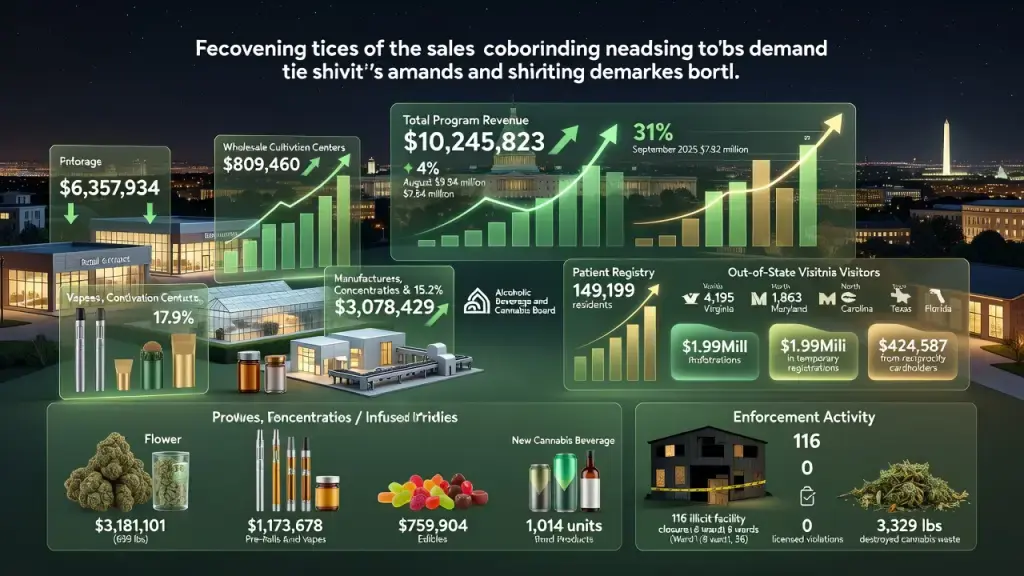
Washington, D.C.'s medical cannabis program posted $10,245,823 in total revenue for September 2026, snapping back from a late-summer soft patch. That's a near-4% bump over August's $9.84 million and a 31% jump from September 2025's $7.82 million, according to the latest monthly report from the Alcoholic Beverage and Cannabis Board. The headline number tells a recovery story. The breakdown underneath it tells a more interesting one about where the District's cannabis economy is actually gaining ground.
Wholesale Carries the Month, Retail Cools Slightly
Here's the catch: dispensary storefronts, the part of the market most people associate with "cannabis sales," actually slipped. Retail receipts came in at $6,357,934, down 2% from August's $6,489,456 and continuing a drift downward from July's $6.6 million peak. The rebound came from upstream. Cultivation centers posted $809,460 in wholesale revenue, up 17.9% month-over-month and more than 53% year-over-year. Manufacturers did even better, climbing 15.2% to $3,078,429, up nearly 49% from a year earlier. In practice, that means processors turning flower into vapes, concentrates, and infused products are capturing a growing share of program dollars, even as front-counter traffic softens. For multi-license operators running vertically integrated operations, that shift matters: margin is migrating toward production and formulation, not the budroom.
Patient Registry Hits Another High, Visitors Still Matter
D.C.'s resident patient registry grew to 149,199 in September, up from 143,556 in August. That's a steady climb, not a spike, and it reflects a maturing medical program rather than a one-time surge. What's striking is how much weight out-of-state visitors still carry. Self-certified temporary registrations rose to 12,823, generating roughly $1.99 million in retail sales, with Virginia residents accounting for nearly a third of those registrations (4,195), followed by Maryland (1,863), North Carolina, Texas, and Florida. Reciprocity patients holding state-issued medical cards added another $424,587, led by Maryland and Virginia cardholders. For dispensary operators near the District line, this isn't a footnote - it's a meaningful slice of foot traffic that depends entirely on D.C.'s registration rules staying accessible to non-residents. Any tightening of self-certification or reciprocity policy would hit storefront revenue directly.
Product Mix Shifts Toward Vapor and Concentrate
Flower remains the top revenue category at $3,181,101 across 699 pounds sold, but volume kept sliding - down from 737 pounds in July and 726 in August. Pre-rolls added $716,688. The more telling movement is in concentrates: sales jumped from 3.2 pounds ($26,265) in August to 8.7 pounds ($50,146) in September, a sharp swing for a relatively small category. Vape cartridges brought in $1,173,678 across 23,300 units, and edibles held steady at $759,904 across 22,019 units. September also marked the first commercial data point for cannabis beverages - 1,014 units for $11,834. That's a modest debut, and it should be read as exactly that: an early entry into retail menus, not a category inflection. For brands and distributors, it's a signal worth tracking over several months rather than a trend to build forecasts on.
Enforcement and Market Structure
The operational side of the report is just as relevant to compliance teams as the revenue figures. ABCA recorded zero facility closures and zero observed violations among licensed operators in September - a clean month on paper. Regulators also destroyed 3,329 pounds of cannabis waste, more than double August's 1,440 pounds, which points to tighter inventory turnover enforcement or simply more product moving through the system that eventually ages out. The licensed retail footprint grew modestly, from 65 to 67 operational dispensaries. Meanwhile, the District's padlocking campaign against unlicensed operators continued, with 116 illicit facilities closed across all eight wards - Ward 1 leading at 36 closures, followed by Ward 2 (19) and Ward 6 (17). For licensed operators absorbing tax obligations, testing costs, and seed-to-sale tracking under METRC, that enforcement activity is directly relevant: every illicit shop that stays open undercuts compliant retailers on price while skipping the lab testing and packaging standards legal operators are required to meet.